This feature is still under development and will be available soon. If you have any questions, please
Contact usJob Fit Analysis
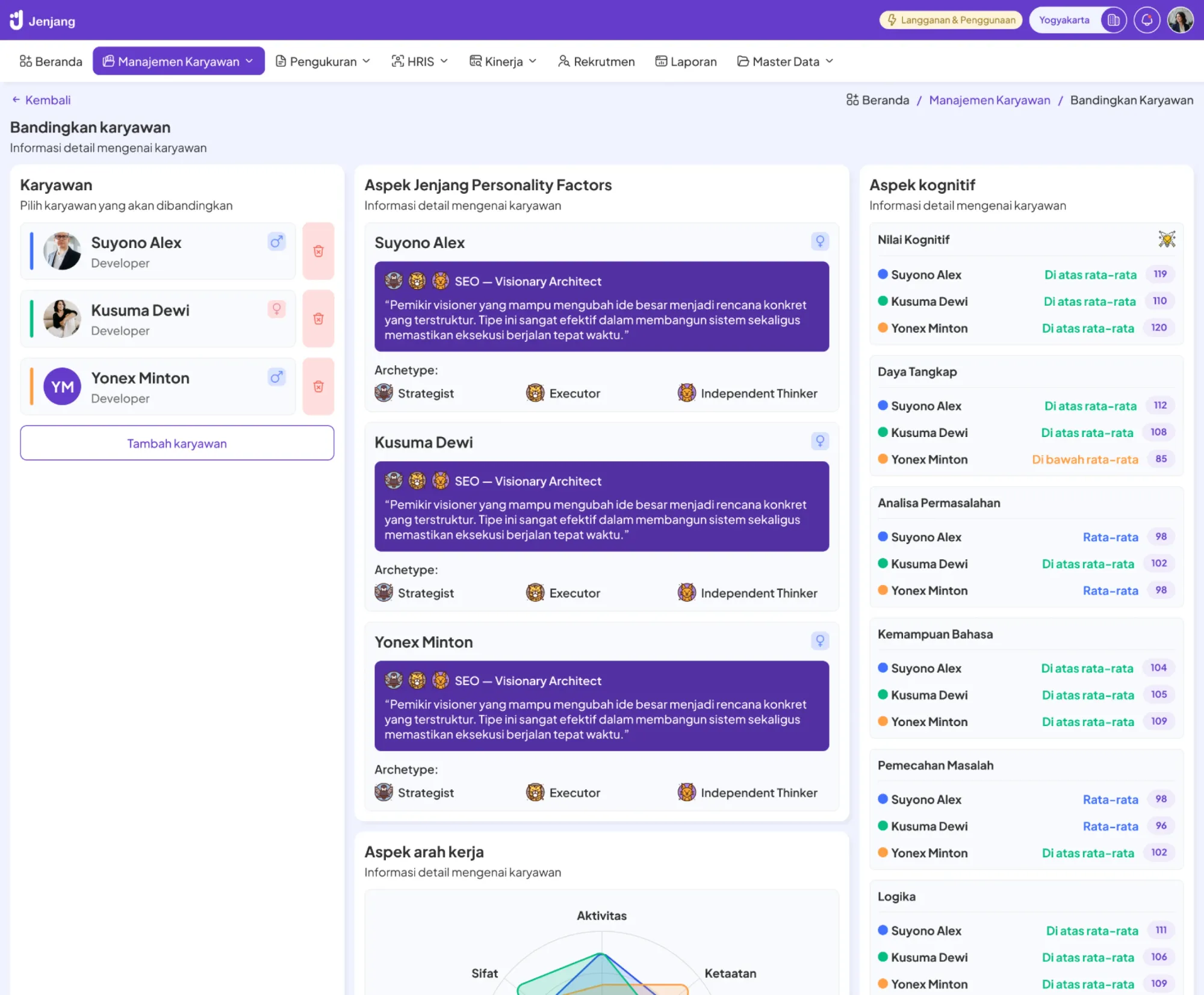
Measure candidate or employee compatibility with role requirements based on work style, work behavior, and role preferences—with clear Fit Score and gaps.
Good People, But Not Always Fit for That Role
Without measurable job-fit, organizations often rely on CVs and interviews to assess compatibility. As a result, mismatches only appear after starting work: communication doesn't click, work styles don't align, role expectations don't match, and ultimately team performance is affected.
Hard to adapt
Candidates/employees look "good", but struggle to adapt to the role and team's work style.
Problems arise
Collaboration, communication, or work rhythm issues only emerge after starting.
Repeated rotation
Internal rotation is often trial-and-error because there's no work style compatibility baseline.
Unfocused
Coaching is unfocused because behavior/soft skill gaps aren't clearly mapped.
Low consistency
Placement decisions easily become debates because there are no consistent indicators.
Measurable Role Compatibility from Relevant Data
Jenjang calculates job-fit from work style & work behavior compatibility against role demands, reinforced by role preferences (Interests & Talents) and readiness signals (if available). The output is Fit Score + gap areas so placement decisions are clearer and development follow-ups are more targeted.
Work Style Fit Score
Work style compatibility score against role demands—built from standardized assessments.
Role Preference Fit
Reads role preference alignment to reduce long-term mismatches.
Actionable Recommendation
Clear placement + development focus recommendations (adaptation, coaching focus).
From Role Expectations to Profile, to Fit Score
Job Fit Analysis at Jenjang compares role expectations with individual profiles based on assessments and work behavior data. Results can be used for candidates or internal placements.
Define soft skill and work style expectations for the role (e.g., collaboration, communication, problem solving, work rhythm, leadership if needed).
Individual profile is formed from Psychological Assessment (Personality Factors, Work Direction), plus Interests & Talents to read role preferences.
If the organization uses Perspective 360, results become reinforcement of actual field behavior.
System calculates total and per-dimension compatibility scores for transparency during discussions.
Surface priority gaps and mismatch risk areas (most impactful on work in that role).
Recommendation: fit with support (adaptation/coaching), or consider alternative role.
Built from Assessment & Real Behavior Signals
Job Fit focuses on accountable data to read work style and behavior compatibility in the role.
Reads work style, collaboration patterns, communication, and how one responds to challenges in a standardized way.
Work style preferences (structured vs flexible, detail vs big-picture) to assess alignment with role demands.
Role preferences and interest direction to reduce long-term mismatches.
Real field behavior reinforcement from multi-raters (collaboration, communication, problem solving, adaptation, leadership, etc.).
Performance/progress summary from internal data (e.g., KPI/OKR summary, coaching outcome) as readiness context.
Output Ready for Decisions
Jenjang displays easy-to-read summaries for HR and leaders—so placement decisions are faster and more consistent.
Fit Score Summary
Total score + highlight of strongest dimensions and those needing most support.
Gap Breakdown
Priority gap areas (soft skill/work style) affecting effectiveness in the role.
Risk Signals
Potential mismatch signals needing mitigation (e.g., work rhythm, communication patterns, collaboration).
Role Comparison
Compare 1 person against multiple roles based on work-style & preference fit.
Recommendation View
Placement recommendation + suggested adaptation/coaching focus.
Reused in Other Features
Job Fit Analysis output becomes data that can be leveraged across Jenjang features for more accurate talent decisions.
Psychological Assessment
Assessment data becomes a baseline for comparing and evaluating candidates or employees consistently.
Learn MoreATS (Recruitment)
Automated recruitment pipeline from CV intake, Fit Score, to qualification-based interview invitations.
Learn MoreHRIS
Manage employee data, attendance, leave, and other HR activities in one integrated platform.
Learn MorePayroll
Automatically calculate payroll from attendance, overtime, and leave data, with flexible components and layered owner approval.
Learn More1 on 1 Coaching & Counselling
Makes coaching plans more precise from gap/strength areas, not just assumptions.
Learn MoreTalent Mapping
Mapping potential, readiness, and development areas for more strategic talent management.
Learn MorePerformance Measurement
KPI measurement and objective performance evaluation with measurable data baselines.
Learn MoreJenjang Digital Identity
Track records and achievements become a valuable, verifiable digital identity.
Learn MoreWhy choose Jenjang Job Fit
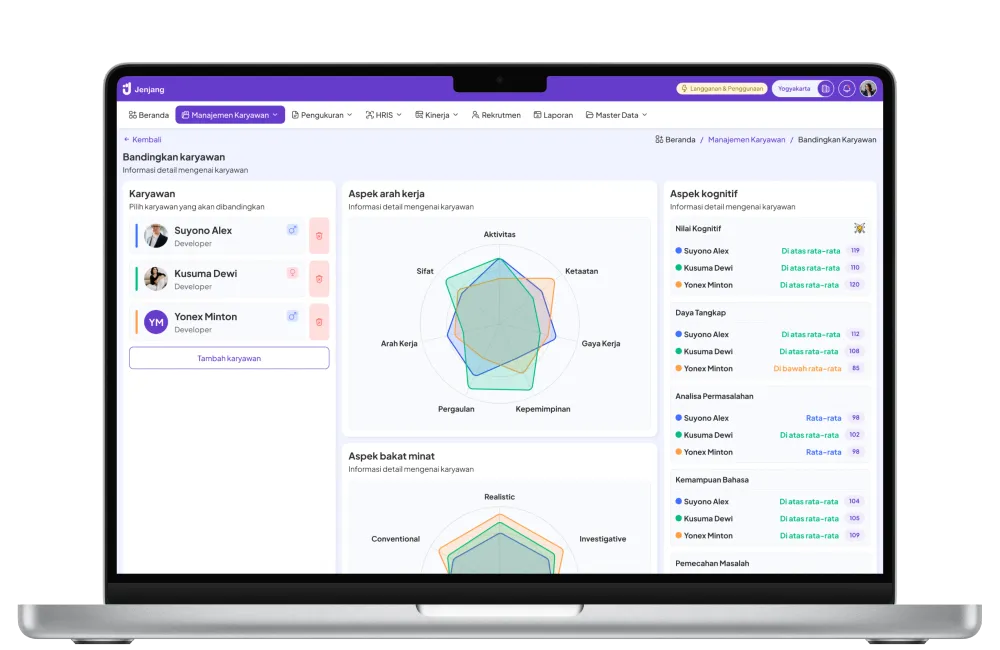
Jenjang assesses job-fit based on factors that most determine daily work effectiveness: work style, behavior, and role preferences. This assessment is built from standardized assessments and reinforced by real behavior indicators in the work environment.
Consistent
Focus on work style & work behavior that are more consistent to assess
Standardized
Standardized assessments produce baselines that can be compared across candidates/employees
Perspective 360
Perspective 360 (optional) reinforces field behavior data
Clear Gaps
Gaps and mismatch risks are clearly visible for adaptation/coaching plans
Talent Mapping
Becomes Role Fit input for Talent Mapping and development recommendations
Targeted Promotion
Helps rotation/promotion be more targeted, reducing trial-and-error
Consistent
Focus on work style & work behavior that are more consistent to assess
Standardized
Standardized assessments produce baselines that can be compared across candidates/employees
Perspective 360
Perspective 360 (optional) reinforces field behavior data
Clear Gaps
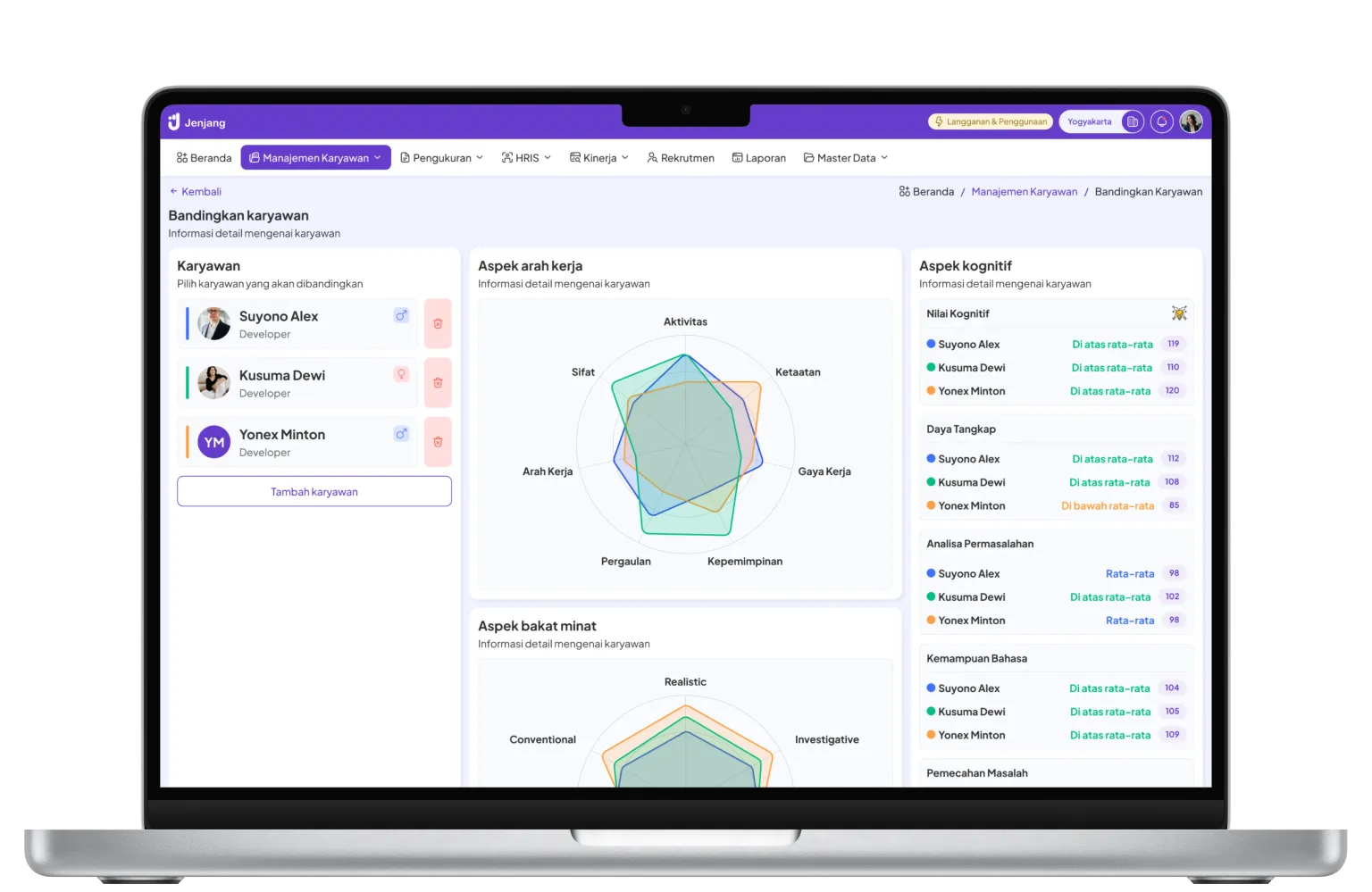
Gaps and mismatch risks are clearly visible for adaptation/coaching plans
Talent Mapping
Becomes Role Fit input for Talent Mapping and development recommendations
Targeted Promotion
Helps rotation/promotion be more targeted, reducing trial-and-error

Download Jenjang Now
Experience a better way to use the Jenjang app, with various features ready to help you in your activities. Download the Jenjang app on: